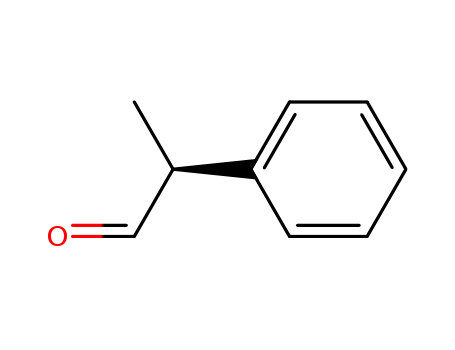
• 2-PHENYLPROPIONALDEHYDE

2-PHENYLPROPIONALDEHYDE

  • CasNo:93-53-8
  • Purity:99%

Product Details;

CasNo: 93-53-8

Molecular Formula: C9H10O

Appearance: clear colorless liquid

Reputable manufacturer supply 2-PHENYLPROPIONALDEHYDE 93-53-8 in stock with high standard

  • Molecular Formula:C9H10O
  • Molecular Weight:134.178
  • Appearance/Colour:clear colorless liquid 
  • Vapor Pressure:0.294mmHg at 25°C 
  • Melting Point:60 °C 
  • Refractive Index:n20/D 1.517(lit.)  
  • Boiling Point:202.339 °C at 760 mmHg 
  • Flash Point:76.111 °C 
  • PSA:17.07000 
  • Density:0.981 g/cm3 
  • LogP:1.98900 

2-PHENYLPROPIONALDEHYDE(Cas 93-53-8) Usage

Preparation

By alkaline condensation of acetophenone and ethyl chloroacetate; also by distillation of methylphenyl ethylene glycol in 91% yields (under atmospheric pressure).

Synthesis Reference(s)

Journal of the American Chemical Society, 97, p. 5608, 1975 DOI: 10.1021/ja00852a062Organic Syntheses, Coll. Vol. 3, p. 733, 1955Tetrahedron Letters, 15, p. 3059, 1974

Flammability and Explosibility

Nonflammable

Trade name

Floralozone (IFF), Florazon (Symrise).

Safety Profile

: Moderately toxic by ingestion. Combustible liquid. When heated to decomposition it emits acrid smoke and irritating fumes. See also ALDEHYDES.

Purification Methods

It may contain up to 15% of acetophenone. Purify it via the bisulfite addition compound [Lodge & Heathcock J Am Chem Soc 109 3353 1987] and see Chapter 2 for preparation and decomposition of bisulfite adducts. [Beilstein 7 IV 695.]

General Description

2-Phenylpropionaldehyde is used in perfumes for its green hyacinth odor.

InChI:InChI=1/C9H10O/c1-8(7-10)9-5-3-2-4-6-9/h2-8H,1H3

93-53-8 Relevant articles

Chiral diphosphite-modified rhodium(0) nanoparticles: Catalyst reservoir for styrene hydroformylation

Axet, M. Rosa,Castillon, Sergio,Claver, Carmen,Philippot, Karine,Lecante, Pierre,Chaudret, Bruno

, p. 3460 - 3466 (2008)

The organometallic synthesis of rhodium ...

Preparation of carbonyl rhodium polyether guanidinium ionic liquids and application in asymmetric hydroformylation based on homogeneous catalysis-biphasic separation system

Guo, Zhenmei,Liu, Baoquan,Liu, Xiangxue,Lv, Zhiguo,Wang, Ke,Zhang, Chao

, (2021)

Four carbonyl rhodium polyether guanidin...

Rhodium catalysed asymmetric hydroformylation with diphosphite ligands based on sugar backbones

Buisman,Martin,Vos,Klootwijk,Kramer,Van Leeuwen

, p. 719 - 738 (1995)

Chiral disphosphite ligands (PP) prepare...

Regio- and Diastereoselective Samarium-Mediated Allylic Benzoate Reductions

Stockdale, Trevor F.,O'Neil, Gregory W.

, p. 2267 - 2271 (2017)

A regio- and diastereoselective samarium...

Tunable furanoside diphosphite ligands. A powerful approach in asymmetric catalysis

Dieguez, Montserrat,Ruiz, Aurora,Claver, Carmen

, p. 2957 - 2963 (2003)

A series of highly tunable furanoside di...

Diphosphite ligands based on ribose backbone as suitable ligands in the hydrogenation and hydroformylation of prochiral olefins

Pamies, Oscar,Net, Gemma,Ruiz, Aurora,Claver, Carmen

, p. 1097 - 1108 (2000)

Rh(I) and Ir(I) cationic complexes [M(co...

Deracemization through photochemical E/Z isomerization of enamines

Huang, Mouxin,Luo, Sanzhong,Pan, Tianrun,Zhang, Long

, p. 869 - 874 (2022/03/07)

Catalytic deracemization of a-branched a...

Are Highly Stable Covalent Organic Frameworks the Key to Universal Chiral Stationary Phases for Liquid and Gas Chromatographic Separations?

Cui, Yong,Jia, Wenyan,Li, Yanan,Yu, Ziyun,Yuan, Chen,Yuan, Li-Ming,Zi, Min

, p. 891 - 900 (2022/02/03)

High-performance liquid chromatography (...

Asymmetric Hydroformylation Using a Rhodium Catalyst Encapsulated in a Chiral Capsule

Jongkind, Lukas J.,Reek, Joost N. H.

, p. 867 - 875 (2020/03/03)

Supramolecular capsules can be used to c...

93-53-8 Process route

styrene
100-42-5,25038-60-2,25247-68-1,28213-80-1,28325-75-9,79637-11-9,9003-53-6

styrene

carbon monoxide
201230-82-2

carbon monoxide

3-phenyl-propionaldehyde
104-53-0

3-phenyl-propionaldehyde

ethylbenzene
100-41-4,27536-89-6

ethylbenzene

(S)-2-phenyl-propionaldehyde
93-53-8

(S)-2-phenyl-propionaldehyde

(R)-2-phenylpropanal
93-53-8

(R)-2-phenylpropanal

Conditions
Conditions Yield
With [(2S,3S)-2,4-bis(diphenylphosphino)pentane]Pt(SnCl3)Cl; hydrogen; In toluene; at 40 ℃; for 138h; under 51714.8 Torr;
68.7 % Chromat.
25%
6.3%
With hydrogen; PtCl2; In toluene; at 40 ℃; for 160h; under 60004.8 Torr; Product distribution; var. PtCl2-diphosphine 2,4-bis(diphenylphosphino)pentane (BDPP)-tin(II)fluoride catalytic system; other temp. and time;
 
With hydrogen; bis(benzonitrile)dichloroplatinum(II); tin(ll) chloride; (2S,4S)-2,4-bis[((S)-dinaphtho[2,1-d:1',2'-f][1,3,2]dioxaphosphepin-2-yl)oxy]pentane; In toluene; at 100 ℃; for 2h; under 76000 Torr; Title compound not separated from byproducts;
 
With hydrogen; bis(benzonitrile)dichloroplatinum(II); tin(ll) chloride; (2S,4S)-2,4-bis[((S)-dinaphtho[2,1-d:1',2'-f][1,3,2]dioxaphosphepin-2-yl)oxy]pentane; In toluene; at 17 ℃; for 70h; under 76000 Torr; Title compound not separated from byproducts;
 
With chiral bis(octahydrodinaphthodioxaphosphepin)-based ligand; hydrogen; tin(ll) chloride; bis(benzonitrile)dichloroplatinum(II); In toluene; at 23 ℃; for 20h; Title compound not separated from byproducts;
 
With hydrogen; [Rh(NBD)(S)-BINAPO]BF4; In toluene; at 40 ℃; for 15h; under 60004.8 Torr; Further Variations:; Catalysts; Solvents; Temperatures; Product distribution;
 
With hydrogen; chiral bis(phosphite)PtCl2-SnCl2; In toluene; at 100 ℃; for 2h; under 76000 Torr; Product distribution; other temp., times, solvent and catalyst;
 
With (2S,4S)-2-(dibenzophospholyl)-4-(diphenylphosphino)pentane; hydrogen; tin(ll) chloride; bis(benzonitrile)dichloroplatinum(II); In toluene; at 24 ℃; for 45h; under 148200 Torr; Further Variations:; Catalysts; Temperatures; Pressures; Kinetics; Product distribution;
 
With hydrogen; tris(pentafluorophenyl)borate; In toluene; at 100 ℃; for 24h; under 60006 Torr; Title compound not separated from byproducts.;
 
With C24H23Cl3P2Pt; hydrogen; tin(ll) chloride; In toluene; at 100 ℃; for 24h; under 30003 Torr; optical yield given as %ee; chemoselective reaction; Autoclave; Inert atmosphere;
 
With (R(P),R(P))-cis-bis(1-propyl-3-methyl-3-phospholano)-dichloro-platinum(II); hydrogen; tin(ll) chloride; In toluene; at 100 ℃; for 96h; under 60006 Torr; optical yield given as %ee; regioselective reaction; Inert atmosphere;
 
With cis-[bis(1-ethyl-3-methyl-3-phospholeno)-dichloro-platinum(II)]; hydrogen; tin(ll) chloride; In toluene; at 60 ℃; for 72h; under 60006 Torr; Reagent/catalyst; Temperature; Time; enantioselective reaction; Inert atmosphere; Autoclave;
29 % ee
With PtCl2{(-)-(2S,4S)-2,4-bis(diphenylphosphino)pentane}; hydrogen; tin(ll) chloride; In toluene; at 60 ℃; for 18h; under 60006 Torr; Temperature; enantioselective reaction; Inert atmosphere; Autoclave;
40 % ee
With PtCl2{(-)-(2S,4S)-2,4-bis(diphenylphosphino)pentane}; hydrogen; tin(ll) chloride; In toluene; at 100 ℃; for 3h; under 60006 Torr; Temperature; enantioselective reaction; Inert atmosphere; Autoclave;
7 % ee
With cis-[bis((S)-1-isopropyl-3-methyl-3-phospholeno)dichloroplatinum(II)]; hydrogen; tin(ll) chloride; In toluene; at 100 ℃; for 24h; under 60006 Torr; Temperature; enantioselective reaction; Inert atmosphere; Autoclave;
10 % ee
With cis-[bis((R)-4-chloro-1-phenyl-5-methyl-1,2,3,6-tetrahydrophosphinino)-dichloroplatinum(II)]; hydrogen; tin(ll) chloride; In toluene; at 100 ℃; for 10h; under 60006 Torr; Temperature; Time; chemoselective reaction; Catalytic behavior; Inert atmosphere;
8 % ee
With {(R)-binap}PtCl2; hydrogen; tin(ll) chloride; In toluene; at 40 ℃; for 120h; under 30003 Torr; Temperature; enantioselective reaction; Autoclave; Schlenk technique;
32 % ee
With {(R)-binap}PtCl2; hydrogen; tin(ll) chloride; In toluene; at 60 ℃; for 120h; under 60006 Torr; enantioselective reaction; Autoclave; Schlenk technique;
16 % ee
With {(R)-binap}PtCl2; hydrogen; tin(ll) chloride; In toluene; at 100 ℃; for 23h; under 30003 Torr; Temperature; enantioselective reaction; Autoclave; Schlenk technique;
24 % ee
With {(R)-binap}PtCl2; hydrogen; tin(ll) chloride; In toluene; at 100 ℃; for 23h; under 60006 Torr; Temperature; enantioselective reaction; Autoclave; Schlenk technique;
24 % ee
With (S)-5,5 ′-bis[di(3,5-xylyl)phosphino]-4,4 ′-bi-1,3-benzodioxole; di-μ-chlorobis(norbornadiene)dirhodium(I); hydrogen; at 60 ℃; for 24h; under 60006 Torr; Autoclave; Schlenk technique;
 
styrene
100-42-5,25038-60-2,25247-68-1,28213-80-1,28325-75-9,79637-11-9,9003-53-6

styrene

carbon monoxide
201230-82-2

carbon monoxide

3-phenyl-propionaldehyde
104-53-0

3-phenyl-propionaldehyde

ethylbenzene
100-41-4,27536-89-6

ethylbenzene

(S)-2-phenyl-propionaldehyde
93-53-8

(S)-2-phenyl-propionaldehyde

Conditions
Conditions Yield
With hydrogen; PtCl(SnCl3)<(S,S)-BDPP>; In toluene; at 40 ℃; for 55h; under 60004.8 Torr;
31%
3%
42%
With hydrogen; PtCl(SnCl3)<(S,S)-BDPP>; In toluene; at 40 ℃; for 55h;
42%
3%
31%
With C44H32Cl4P2PtSn(2+); hydrogen; at 40 ℃; for 336h; under 30003 Torr; Reagent/catalyst; Solvent; Temperature; Time; Pressure; chemoselective reaction;
49 % ee

93-53-8 Upstream products

  • 34713-70-7
    34713-70-7

    2-Phenylpropanal

  • 100-42-5
    100-42-5

    styrene

  • 201230-82-2
    201230-82-2

    carbon monoxide

  • 934-10-1
    934-10-1

    3-phenylbut-1-ene

93-53-8 Downstream products

  • 65878-65-1
    65878-65-1

    (2S,3R)-threo-2-phenylpentan-3-ol

  • 65878-64-0
    65878-64-0

    (2S,3S)-erythro-2-phenylpentan-3-ol

  • 36041-82-4
    36041-82-4

    methyl (3R,4S)-3-hydroxy-4-phenylpentanoate

  • 36041-82-4
    36041-82-4

    Methyl-erythro-3-Hydroxy-4-phenylvalerat

Inquiry

Name:
*CompanyName:
*Email:
*Requirements:
*Code:
Submit